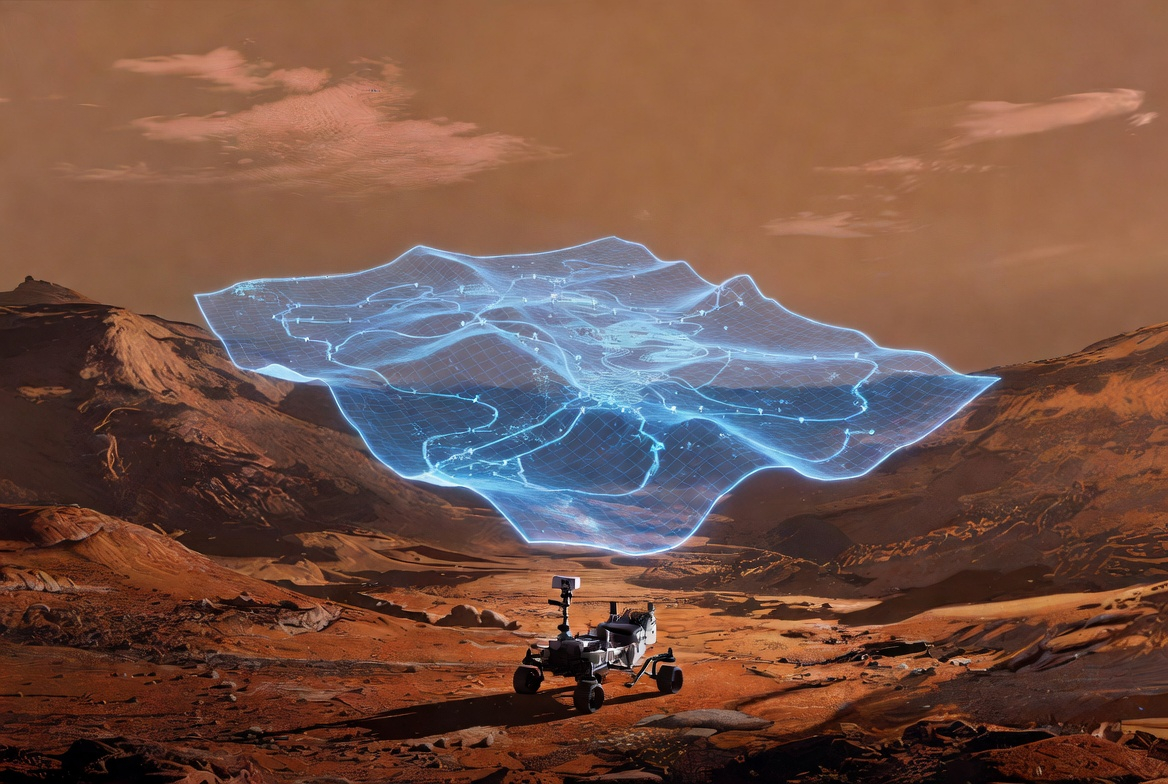
Picture this: a six-wheeled robot the size of a car sits on the surface of another planet, 140 million miles from the nearest human being. No one told it exactly where to go. An AI planned the trip. And it worked. On February 2, 2026, NASA confirmed that the NASA AI Mars rover autonomous 2026 milestone had officially been crossed – the Perseverance rover had completed the first drives on Mars whose routes were designed entirely by artificial intelligence. This isn’t science fiction. NASA AI Mars rover autonomous 2026 moment just happened. And the implications stretch far beyond one crater on a red desert world.
The Breakthrough Nobody Saw Coming (Until They Did)
The actual drives took place on December 8 and 10, 2025, deep inside Jezero Crater – a dried-up lake bed that scientists believe once held the ingredients for microbial life. On the first day, Perseverance rolled 689 feet (210 meters). On the second, it pushed further: 807 feet (246 meters). Neither distance is record-breaking on its own. What was record-breaking was who – or what – designed the route.
For years, every step Perseverance took was pre-planned by human engineers back on Earth. They’d pore over orbital photos, hand-draw paths, and laboriously build out waypoints one segment at a time. It worked. But it was slow, resource-intensive, and capped by what human planners could process in a day. The new system flips that bottleneck on its head.
Here’s what makes NASA AI Mars rover autonomous 2026 moment stick: NASA didn’t just let an AI suggest a route. They let it design the whole drive end-to-end, and then they sent those commands 140 million miles across space and trusted a $2.7 billion rover to follow them. That’s a different kind of confidence. That’s a threshold being crossed.
How the NASA AI Mars Rover Autonomous 2026 System Works
The brain behind these historic drives is a vision-capable generative AI, developed in collaboration with Anthropic using Claude-based models. Think of it as the same family of AI that reads and writes natural language – but here, it’s been trained to “see” Mars from orbit and translate what it sees into movement.
What Data Does the AI Actually Use?
The AI ingests the same datasets that human planners work from. Specifically, it’s fed:
- HiRISE orbital images from NASA’s Mars Reconnaissance Orbiter – extraordinarily detailed satellite photography of the Martian surface
- Digital elevation models and slope maps that give a 3D picture of hills, cliffs, and gradients
- Terrain classification data flagging bedrock, boulder fields, sand ripples, and other hazards
From that input, the AI doesn’t just pick from a menu of pre-approved paths. It generates entirely new routes from scratch – identifying safe corridors, tagging risks, and producing a full sequence of waypoints from start to finish. That’s generative planning: constructing something new, not just choosing between pre-made options.
The Digital Twin Safety Net
Before any AI-designed route was beamed to Mars, NASA ran it through a digital twin of Perseverance at JPL – a high-fidelity virtual clone of the rover and its control software. The simulation checked more than 500,000 telemetry variables for potential failures. Would the rover tip? Would it stress a wheel joint beyond its limit? Only if the digital twin gave a clean bill of health did the commands go live.
The pipeline looks like this: orbital images and terrain data feed into the vision AI, which generates a route, which gets stress-tested in the digital twin, which – if it passes – gets uplinked to the real rover on Mars. It’s rigorous. It’s engineered to be paranoid about failure. And it worked on the first attempt.
Two Layers of Autonomy Working in Tandem
Here’s something that often gets lost in the headlines: the AI route planner isn’t Perseverance’s first brush with autonomy. The rover already carries a system called Enhanced Autonomous Navigation (ENav) – a sophisticated onboard navigator that lets it scan its immediate surroundings, evaluate thousands of short paths in real time, and pick safe steps while driving.
ENav is impressive on its own. It runs on radiation-hardened hardware roughly equivalent to a late-1990s desktop computer – not exactly a gaming rig – yet it’s enabled Perseverance to complete roughly 90% of its total travels autonomously and set records for autonomous distance in a single Martian day.
But ENav has a limitation: it’s local. It sees a few meters ahead. It can’t look at a satellite photo and plan a 246-meter traverse through boulder fields and sand traps. That’s exactly what the new AI layer does.
Think of it this way:
- The generative AI route planner is the long-range strategist: “Here’s how we get from Point A to Point B, avoiding every major hazard along the way.”
- ENav is the real-time tactician: “Given what my cameras see right now, here’s exactly how I place each wheel.”
On December 8 and 10, both systems worked together seamlessly. The AI designed the mission, ENav executed it. Humans watched from 140 million miles away.
Why the NASA AI Mars Rover Autonomous 2026 Milestone Changes Everything
Speed and Scale of Exploration
The most immediate payoff is efficiency. Human planners can only process so much data in a day. They have meetings, they have shifts, they have cognitive limits. AI doesn’t. A system that can generate a week’s worth of driving routes overnight means science teams wake up every morning with more options, more distance covered, more of Mars within reach.
That translates directly into faster daily drives, viable kilometer-scale traverses, and access to terrain that was previously too time-consuming to route through – crater rims, river delta formations, canyon systems. Places where the best science might be hiding, but where getting there has always been the bottleneck.
Why Autonomy Becomes Non-Negotiable in Deep Space
Here’s the uncomfortable truth about exploring the outer solar system: the communication delay only gets worse from here. Mars already introduces up to a 21-minute one-way signal lag. You can’t joystick anything in real time. Every command has to be pre-planned, pre-validated, and trusted to execute without supervision.
Push a mission toward Jupiter’s moon Europa or Saturn’s moon Titan – places where subsurface oceans and methane lakes make for tantalizing science – and the delays stretch longer, contact windows shrink, and the need for true autonomy isn’t a feature anymore. It’s a survival requirement.
NASA engineers have been direct about this: more advanced autonomous navigation is essential for deep-space missions where real-time human control is a physical impossibility. What Perseverance just demonstrated is the early prototype of what those future systems will look like.
Paving the Road for Human Boots on Mars
It would be easy to frame this as a robot story. It’s really a human story. Before any astronaut sets foot on Mars, we’ll need to know a lot more than we currently do – safe landing zones, accessible resources, viable paths between base camp and science sites. AI-powered autonomous rovers can gather all of that, continuously, without waiting for a human to map each step.
The applications compound quickly:
- Robots scouting hazardous terrain before humans ever arrive
- Autonomous systems pre-positioning power units, supplies, and shelter components
- AI-guided rovers and drones serving as on-site assistants for human crews – think self-driving service vehicles that can respond to emergencies without human commands
None of this is speculative fiction. NASA AI Mars rover autonomous 2026 is the logical extension of what Perseverance just proved works.
The Human-AI Partnership Nobody Needs to Fear
If you’re watching this story of NASA AI Mars rover autonomous 2026 and wondering whether AI is about to make space scientists redundant, here’s the honest answer: no. Not even close. What the Perseverance mission actually reveals is a division of labor that plays to the strengths of both.
Humans still set the scientific agenda. They choose which crater to explore, what rocks are worth sampling, and what discoveries mean. They interpret data and make judgment calls about mission priorities. Those are hard, messy, creative problems – and AI isn’t touching them.
What AI contributes is something different: the ability to digest enormous image datasets in minutes, flag terrain anomalies a human might miss after staring at the same screen for eight hours, and generate safe, optimized routes at a speed and scale no team of engineers could match. It’s the difference between having one expert planner and having a thousand running in parallel, never getting tired.
The future of deep-space exploration looks like a genuine partnership: human curiosity and scientific judgment paired with AI’s tireless analytical power. Neither one is sufficient alone. Together, they just drove a rover across Mars without anyone holding the wheel.
The Architecture That Scales to Any World
What’s particularly exciting about this system – AI route planner + local onboard autonomy + digital twin verification – is how transferable it is. The same architecture works whether you’re navigating a crater on Mars, scouting a polar ice shelf on the Moon, threading through boulder fields on an asteroid, or guiding a drone through Titan’s nitrogen atmosphere.
Ingenuity, NASA’s Mars helicopter, already proved that aerial autonomy on another planet was possible. The new AI planning layer proves that strategic, end-to-end route design is possible too. Stack those together and you’ve got a blueprint for the next generation of robotic explorers – faster, smarter, and capable of operating in places where a human operator simply can’t keep up.
Final Thoughts on NASA AI Mars Rover Autonomous 2026 System
The December drives in Jezero Crater weren’t flashy. No one livestreamed them. There was no countdown. A rover moved across a cold, quiet desert on another planet, following a path that an AI designed, and it did so without incident. That’s exactly how historic milestones tend to happen – quietly, technically, and with implications that only become clear in hindsight.
The NASA AI Mars rover autonomous 2026 announcement is one of those moments. It’s the first time a machine on another world followed a travel plan that no human being drew. It won’t be the last.
If you’re as fascinated by where this goes next as we are, bookmark AINetizens.com and follow our ongoing coverage of AI in space exploration. The solar system is about to get a lot more interesting – and AI is holding the map.